
How are vehicles tested for safety?
Safety testing explained
WHAT DO WE TEST?
ANCAP tests and rates popular-selling passenger car, SUVs, utes, vans and light trucks when released as new into Australia and New Zealand.
ANCAP safety ratings are determined through a series of physical crash tests and collision avoidance tests, undertaken in controlled laboratories, test tracks, and on-road.
Our ratings indicate the level of safety a new vehicle provides to occupants, other vehicles, pedestrians, cyclists, and motorcyclists in the event of a crash, as well as the vehicle's ability to avoid or minimise the severity of a crash.
All vehicles rated by ANCAP are evaluated against four key areas of assessment which focus on the protection of vehicle occupants, those outside the vehicle, and the active ability of a vehicle to avoid a severe crash.
The four assessment areas evaluated from 2026 – known as the Stages of Safety – are:

Safe Driving

Crash Avoidance

Crash Protection

Post Crash
These assessment areas are based on the Haddon Injury Prevention Matrix. The Haddon Matrix is a tool used in safety and injury prevention that helps people think about:
What happens before a crash?
What happens during a crash?
What happens after a crash?


Safe Driving
Maximum Score

Crash Avoidance
Maximum Score

Crash Protection
Maximum Score

Post Crash
Maximum Score
Hazard Light Activation
To learn more about the tests and test criteria applied in earlier years, see: How is vehicle safety changing?
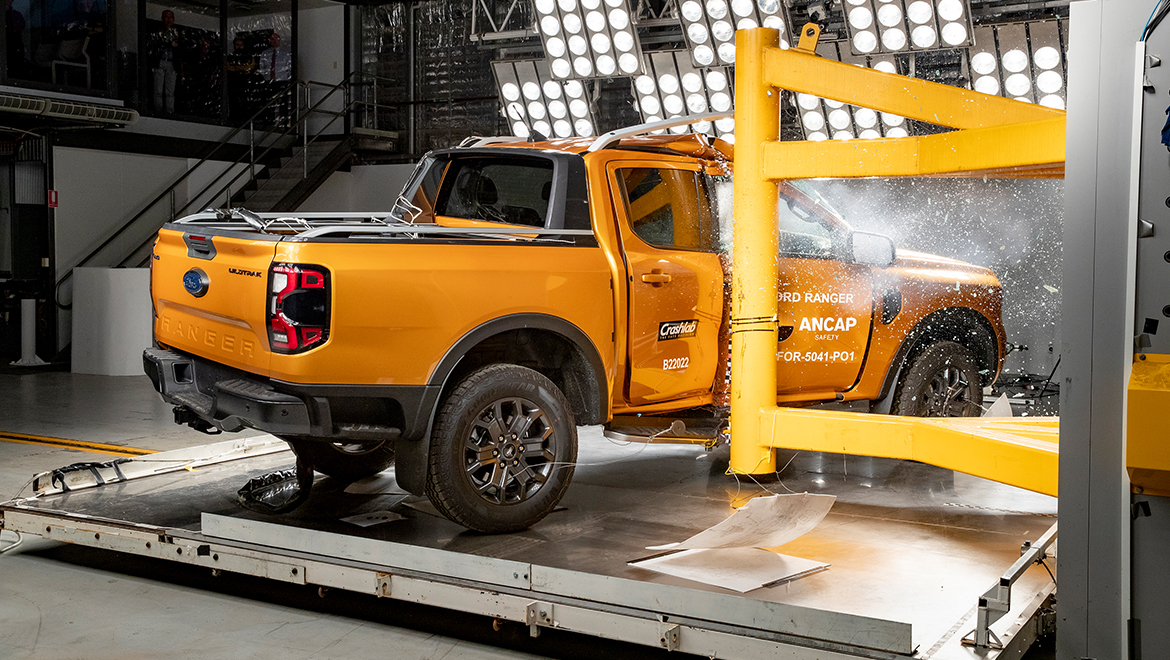
HOW DO WE TEST?
A range of tests and assessments are conducted within each key area of assessment. We refer to these as the Stages of Safety. Vehicles are required to meet minimum score thresholds in each of the four stages. The scores in these stages determine the overall star rating.
Rating requirements (test criteria) are updated every three years to encourage inclusion of the latest safety features and technologies.
CRASH PROTECTION
Physical crash tests
A range of destructive physical crash tests are conducted to simulate the most common types of on-road crashes and evaluate the performance of crash protection systems, including vehicle structure, seatbelts, airbags and head restraints to mitigate injuries to vehicle occupants, pedestrians and cyclists.
Our tests assess frontal impact, side impact, run-off-road, and rear-end whiplash performance. Collisions with pedestrian and cyclists is also assessed.
Watch the videos below to learn more.
Child Occupants
The protection of child occupants is an important element of our testing and rating. It forms part of the Crash Protection stage.
We use child dummies that represent a 6 year old and 10 year old in both the frontal offset and side impact tests to assess how well the vehicle protects children in these crash scenarios. In addition, we also assess vehicle safety features for child occupants, and how well each vehicle can safely accommodate a range of common child restraints – from rearward-facing baby capsules to forward-facing booster seats.
Each of the vehicles rated by ANCAP are assessed with the help of our family of dummies.

CRASH AVOIDANCE
On-track and on-road performance tests
Each vehicle we rate is assessed for the presence and effectiveness of crash avoidance technologies – active safety systems that can help avoid or reduce the severity of a crash through warnings or autonomous intervention.
The technologies assessed include those that can avoid collisions through car-to-car, car-to-pedestrian, car-to-cyclist, and car-to-motorcyclist autonomous emergency braking (AEB); lane support systems (LSS) that can assist with unintended lane departures; and low-speed collision prevention to reduce impacts with cars, pedestrians, cyclists and motorcycles in urban environments like carparks and driveways.
Our on-road driving assessments take vehicles beyond the test track, driving them on a route of metropolitan and regional roads to evaluate the accuracy of on-board speed assistance systems in the Australian road environment. These drives also help us gather real-world data to inform future test requirements and encourage manufacturers to implement well-designed systems.
Seen an ANCAP test vehicle on the road and want to know more about our data collection and privacy policy?
Watch the videos below to learn more.
SAFE DRIVING
Features that help provide a safer driving experience
It is always better to avoid a crash rather than have a good outcome in a crash. Today's new cars can help the driver remain alert; prevent distraction; provide assistance to properly secure occupants; alert the driver to unattended occupants; provide emergency steering assistance; and help maintain safe travelling speeds and distances from other vehicles.
Watch the videos below to learn more.
POST-CRASH SAFETY
Features and requirements to help the rescue response
Emergency services personnel who are first on the scene of a crash to render assistance can be put at risk if they are not aware of the location of high voltage batteries, fuel tanks, airbag inflators and seatbelt pre-tensioners. Their work can also be hampered by locked vehicle doors and windows, and high-strength body structures. These obstacles can delay vital emergency response time for crash victims.
To assist with the safe rescue and extrication of occupants, vehicle manufacturers have been encouraged to provide standardised vehicle information highlighting the location of potential rescue hazards. This information is provided in the form of a Rescue Sheet for all new vehicles since 2020. Easy access to this information is increasingly important as more electric and alternative-powered vehicles are on our roads.
All available Rescue Sheets have been compiled into the ANCAP RESCUE app for use by first responders.
From 2026, energy management is also examined as part of the ANCAP safety rating process – to encourage the safe isolation of high-voltage batteries in EVs and alternative-powered vehicles.
Multi-collision braking – a vehicle's ability to apply the brakes to avoid a subsequent collision – is also assessed, along with the automatic activation of the vehicle's hazard lights, the ability for the vehicle's doors to automatically unlock when a crash occurs, and window and door opening functionality once 12V vehicle power has been lost – either through crash impact or submergence in water.
ANCAP encourages high levels of safety performance across all areas of assessment, and the overall star rating of a vehicle is limited by the lowest performing area of assessment.
Learn more at:
What do the star ratings mean?Large Utes.
Does size matter?
Light Trucks.
How do they compare?
Thinking electric?
Our future can be safe AND green.
Commercial vans.
Are you delivering on safety?
Stay in the know.
Sign-up for the latest ratings and news.
Ask an expert.
Your vehicle safety questions, answered!